-
- EN
-
-

The sample has the right weight, the cuffs recover neatly, and the chest logo sits exactly where you want it. You approve production. Weeks later, the cartons arrive—and the sweatshirt feels different. Some sleeves run short, the rib looks loose, or the print sits lower than it did on the approved piece.
For an apparel brand, those differences can mean product photography that no longer matches the stock, customer complaints, and an expensive decision about whether to delay a launch.
When comparing custom sweatshirt manufacturers, look beyond the sample itself. Ask how its materials, measurements, decoration, and finish become instructions that production teams can follow and inspectors can verify.
To reduce sample-to-bulk variation, approve a production-ready reference, document measurable specifications and tolerances, control material substitutions, and agree on in-process and final checks. This ten-point test helps you evaluate those controls before placing an order. It is a buyer's assessment framework, not a laboratory test or a guarantee that every garment will be identical.
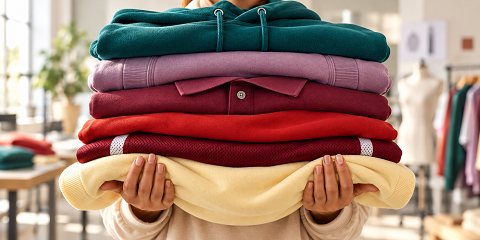
A sweatshirt manufacturer turns a product brief into repeatable garments. Depending on the agreed service scope, that work can include material sourcing, pattern development, sampling, cutting, sewing, decoration, finishing, inspection, and packing, sometimes even shipment.
The scope matters. A business decorating purchased blanks has a different role from a factory developing your own fit and construction. Both can meet appropriate briefs, but they offer different control over the finished garment.
If you need a proprietary silhouette, custom rib dimensions, or specific fabric characteristics, ask who develops and approves those elements. If you are comparing a sweatshirt wholesale supplier with a custom production partner, establish whether the offer covers ready-made stock, decorated blanks, or made-to-order garments.
For a private label project, the useful deliverable is a reproducible product definition: a garment reference supported by materials, measurements, artwork, and inspection requirements.
Making one convincing sample is only the beginning. Repeating it requires control over variables that can change between development and production.
Two fabrics with the same GSM can differ in composition, construction, surface finish, thickness, and handfeel. "Heavyweight fleece" is therefore not a complete specification. Identify the approved fabric and record which characteristics must remain consistent.
A sweatshirt may fit correctly before washing and change afterward. The body fabric and rib may also behave differently, affecting the neckline, cuffs, or hem. Textile construction, processing, and garment care all influence dimensional stability.
Agree on the care procedure and assessment conditions before comparing results. "Pre-shrunk" alone does not specify an acceptable dimensional change.
A color name or a photograph is an incomplete reference for bulk shade acceptance. Discuss the approved physical standard, viewing conditions, and how material lots will be identified and compared. Confirm the required relationship between body fabric, rib, and other visible components.
Cutting, seam construction, sewing tension, and decoration placement all need clear references. A chest graphic that looks centered by eye on one sample may not be consistently positioned across a size range.
The supplier's task is to translate your approval into repeatable operations and detect departures early enough to correct them.
A request for "300 premium sweatshirts" leaves suppliers pricing different products. Send a brief that defines the order well enough for meaningful comparison:
Garment type and fit: crewneck, pullover hoodie, or zip style; intended silhouette and reference images.
Fabric: composition, structure, target GSM, surface and reverse finish, and an approved reference where available.
Measurements: size chart, defined measurement points, size grading, and proposed tolerances.
Rib and trims: composition or reference, dimensions, appearance, and required recovery.
Decoration: artwork, process, dimensions, color reference, and placement by relevant size group.
Order breakdown: quantities by style, color, and size; identify any coordinated products or packs.
Labels and packing: label artwork, attachment positions, folding, packing, and assortment requirements.
Quality and timing: care expectations, required evaluations, sample approval stages, destination, and target delivery date.
If you have not finalized an item, mark it "open for recommendation". Ask the supplier to identify assumptions and separate development or setup charges from the garment price.
A useful quote makes trade-offs visible. It should not quietly replace your chosen fabric or simplify the decoration to reach a target price.
Custom sweatshirt manufacturers may calculate minimums by style, color, total order, or material commitment. Confirm all applicable conditions before deciding how many designs to launch.
For example, an illustrative 300-piece order could contain one color in five sizes or three colors in five sizes. Both total 300, but the second arrangement creates more color-and-size combinations and may require additional material or decoration setups. Whether it is workable depends on the production brief.
Ask whether approved sizes can share a style-and-color minimum, whether body and rib materials have separate minimums, and whether custom labels or packaging add commitments of their own.
Champolian offers starting quantities of 72 pieces per team for selected apparel programs. Final sweatshirt requirements must be confirmed against the style, materials, decoration, and total assortment.
For early stage releases, reducing unnecessary colorways may preserve more budget for development and product checks. A smaller, better-defined collection can be easier to approve and replenish than a fragmented assortment.
First identify what the sample represents. A development sample, such as prototype, may demonstrate fit while using substitute fabric or temporary trims. Before bulk approval, confirm which components and processes are production-representative and which remain unresolved.
Use the following review sequence:
Check against the written brief. Confirm the fabric reference, measurements, construction, trims, decoration, and labels.
Assess fit and appearance. Review the intended silhouette and relevant sizes rather than assuming one size proves the full range.
Review care performance. Use the agreed washing and drying conditions; compare measurements and appearance afterward.
Record decisions. Mark each item approved, requiring correction, or awaiting evidence. Date the approval and identify the sample version.
Retain a production reference. Agree on matching references for the buyer, manufacturer, and inspection team, supported by photographs and specifications.
For illustration, a body length changing from 70 cm to 68 cm represents approximately 2.9% shrinkage: (70 − 68) ÷ 70 × 100. This example is not an acceptance limit. Assess each required measurement against its agreed criterion and the specified test conditions.
Do not approve unresolved issues with a general comment such as "looks good". Write down exactly what can proceed and what must be corrected or confirmed first.
Consistency is best assessed through the production process and its records. Champolian's in-house cut-and-sew sweatshirt manufacturing brings sample making and bulk production under one roof, giving buyers a concrete basis for discussing how development decisions reach production.
Its published quality process includes fabric, cutting, sewing, decoration, final, and packing checks. For your sweatshirt order, agree on the specific inspection scope and the evidence you will receive. Discuss how the approved sample and specification will guide measurement, workmanship, branding, and assortment checks.
Champolian also describes final inspection reporting for client approval before dispatch in its customization workflow. Confirm that arrangement for your order, together with responsibilities for reviewing and resolving any identified deviations.
Before production, settle three practical questions:
Which dated sample and specification are authoritative?
Who must approve changes to materials, construction, or artwork?
What happens if inspection identifies an out-of-tolerance result?
These agreements make the quality discussion actionable. Sampling-based inspection does not establish that every unit is defect-free, and "matches the sample" should mean conformity to the approved specification within agreed limits.
Developing a branded sweatshirt collection? Explore private label apparel manufacturing and share your sample requirements for a project review.
Use these questions during supplier discussions. For each answer, request a relevant record or sample and identify what still needs agreement.
Ask for examples relevant to your intended garment, with composition, structure, GSM, and finishing identified. Confirm whether the quoted material matches the proposed sample and how any substitution would be approved.
Evidence to request: a labeled swatch and fabric specification tied to a relevant garment.
Warning sign: the supplier describes every option simply as "premium cotton" or treats higher GSM as proof of better quality.
Ask how the supplier evaluates dimensional change and how results inform development. Confirm the agreed care procedure, measurement method, and acceptance criteria for the finished product. Consider body fabric and rib together during fabric selection for various types of garments.
Evidence to request: a report identifying the tested material or garment, conditions, measurements, and results.
Warning sign: "zero shrinkage" or "pre-shrunk" without an evaluation method or defined scope.
Ask how the proposed neck, cuff, and hem rib is assessed for appearance, recovery, dimensions, and compatibility with the body fabric. Request a garment-level review, since an isolated swatch cannot show how the components work together.
Evidence to request: an approved rib reference and recorded findings from the agreed stretch/recovery and care assessments.
Warning sign: the rib is selected only by color, with no defined approval for its behavior or fit.
Request a written breakdown for your exact assortment. Include material, decoration, label, and packaging conditions so that a low sewing minimum does not conceal a larger purchasing commitment.
Evidence to request: a quote showing minimums, quantity units, and setup charges separately.
Warning sign: a single advertised MOQ that changes only after development fees have been paid.
Ask which combinations can be grouped and which require separate setups or minimums. Confirm the quantity matrix and how the assortment will be checked before packing. Do not assume that the total order automatically satisfies every color requirement.
Evidence to request: an accepted style/color/size matrix with any restrictions noted.
Warning sign: an informal "yes" without a confirmed breakdown or responsibility for assortment accuracy.
Review the required printing or embroidery technique through the supplier's apparel customization options. Ask where each operation is performed and who controls approval and inspection. Partner-managed work still needs a clear handoff and accountable quality owner.
Evidence to request: a process-specific sample, approved artwork dimensions and placement, and confirmation of who performs and checks the work.
Warning sign: vague "everything in-house" assurances without a process-level explanation.
Ask how the sample, measurement sheet, fabric reference, and artwork revision are linked. Confirm that substitutions and production changes require documented approval. Identify who checks that the factory and buyer are using the same version.
Evidence to request: a dated approval pack and an example of how revisions are recorded.
Warning sign: the only production reference is a photograph or a message saying "same as sample".
Ask which checks occur before cutting, during sewing and decoration, and before packing and shipment. Review the quality assurance process and agree on the inspection plan, defect categories, reporting, and actions for nonconforming findings.
Evidence to request: a relevant anonymized inspection report and a clear corrective-action procedure.
Warning sign: inspection takes place only after the entire order has been packed, or an unexplained AQL number is offered as a complete quality guarantee.
Specify label wording, artwork, dimensions, attachment points, and packing requirements alongside the garment. Confirm whether these details appear on the approval sample or require separate approval before production.
Evidence to request: label and packaging proofs, confirmed inclusions in the quote, and a packing reference.
Warning sign: "private label included" without a definition of which components, quantities, or services are covered.
Ask what can be reused from the first run and what must be reconfirmed. Material availability, dye lots, scheduling, and component minimums can change. A reorder should reference the approved product while allowing necessary changes to be reviewed explicitly.
Evidence to request: a documented repeat-order specification and a current assessment of material availability and production timing.
Warning sign: a guaranteed repeat price, shade, or delivery date without checking the next order's conditions.
How to use the checklist: Mark each point "documented", "needs clarification", or "unresolved." Before approving bulk production, resolve gaps affecting product identity, acceptance criteria, or order feasibility. Do not average away a missing fabric approval because the supplier answered other questions well.
A strong sweatshirt sample shows what is possible. A documented production plan shows how the order will be controlled. Send Champolian your tech pack or sample references, quantities by color and size, artwork, and target delivery date to discuss the development and inspection requirements for your collection.